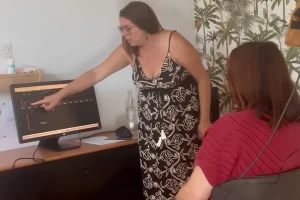
When you choose to organize a team-building seminar, you often ask me to lead it using... the MBTI® tool. Through my various experiences on this subject, I want to share with companies, leaders, managers, HR who are wondering about organizing a group with this tool, the method and the flow of a typical seminar.
Naturally, the content is co-created with the sponsors and tailored to your organization's objectives and needs. No two workshops are alike! In this article, you'll discover the process used with the MBTI® tool to make your group coaching even more effective and impactful.
What is the MBTI®?
The MBTI® (Meyers Briggs Typology Indicator) is the most widely used personality questionnaire in the world. It allows for the exploration of the characteristics of individuals and teams in a positive and constructive way. It is widely used for to unite the members of the management committees and management teams.
The advantage of the MBTI® is that it can be applied to a multitude of requests/needs: working on self-confidence, interpersonal relationships, communication, managerial posture, leadership, performance, motivation, adaptability to change, cohesion, inclusion, etc.
The Steps of the MBTI® Seminar
1. Completion of the questionnaire and individual debriefing
First and foremost, we generally begin with an individual interview with each member of the team involved. Why? Because’We start with the basics: self-knowledge. The questionnaire and the debriefing help to define his MBTI® personality type and to understand its individual functioning, which inevitably has positive and less positive impacts on interaction with other team members.
I take this opportunity to break the ice and build trust with everyone, so that everyone feels comfortable with me during the group workshop.
I gather everyone's expectations, objectives, and needs in order to personalize the support and define the best approach and group exercises.
2. The team seminar
Introduction and Inclusion
The group can be organized over one or two days, either in person or remotely. After introductions, discussions about individual expectations, and inclusion, we begin by asking ourselves the question of which is already working well within the team. Nothing is ever worth throwing away, and it is important to recognize one's strengths, which are pillars for the development and progress of working together.
Group exercise: Working Group vs. Team
Through a fun exercise, we cover the Differences between a working group and a team. This makes participants aware of their positioning and what they do or do not do like a real team.
Exploring the Dimensions of the MBTI®
Let's go! exercises and practical cases from the MBTI® collective. We explore through fun games, theoretical input and serious games, The different dimensions of the MBTI®. This is an opportunity for everyone to observe their own reactions and those of others. This facilitates the acceptance that we do not all react in the same way and that our behaviors, even if they may be surprising or even irritating to others, do not stem from a conscious and negative intention to annoy others, but rather from a matter of personality. This strengthens trust and helps to allow oneself to be more oneself with others, with a feeling of safety and well-being to express themselves freely. Everyone now knows how to adapt to each other for better interpersonal communication.
The MBTI dimensions explore how we recharge. (Extraversion / Introversion), the type of information we collect (Sensation / Intuition), our decision-making style (Thought / Feeling) And finally, the way we organize the world around us (Judgment / Perception).
Concrete Examples
For example, an "Introverted" person« will need to observe and reflect before answering a question. She will need calm, even solitude, to recharge and perform well, whereas’an "Extroverted" person« will need interaction and will be more spontaneous in her responses. A person with "Intuition"« will have a comprehensive view of the data around her, whereas’a "Sensational" person« will need to explore the details.
3. Team Decision-Making Process
Once everyone has shared their individual working methods and the associated needs they would like to address in teamwork, we work specifically on the team's decision-making process. In the MBTI®, this is called the Z process. This allows us to become aware of the key elements that the team uses in its decision-making and to identify whether it is not forgetting to spend more time reflecting on an important aspect or spending too much on another.
For example, perhaps the team tends to get bogged down in too many practical details and forgets to make connections through the analysis of the big picture. Perhaps members spend too much time exploring logical and pragmatic criteria and overlook the human impact of their decisions. This also allows them to learn to leverage each other's strengths, as not everyone has the same skills and preferences for exploring all the elements necessary for a comprehensive and relevant decision.
Specific Themes
At the end of this step, we usually delve deeper into a theme on which the team wishes to improve, such as giving and receiving feedback, working on its leadership and coaching management style, its emotional intelligence, improve one's ability to communicate assertively, learn how to develop motivation within its teams, supporting change, defining the vision and mission of its organization and translating it into strategic and operational objectives, improving how team meetings work etc.
KISS Action Plan
Finally, we establish a concrete KISS (Keep, Improve, Stop, Start) action plan, which allows us to both list the existing positive elements within the team and the areas for improvement to be implemented. The team leaves with... SMART action priorities to be implemented in the short, medium and long term, for which she has appointed the people responsible and the deadline for completion, and whose progress and status she will monitor at each team meeting.
4. Re-looping Seminar
Six months to a year after the group workshop, we generally organize a follow-up seminar. At this seminar, we discuss achievements, remaining points to develop, and We delve deeper into certain topics at the request of the participants.
Conclusion
So, what do you think? If this makes you want to organize a group session using the MBTI® for your executive committees and/or management teams, and you would like to learn more, I invite you to visit the dedicated page on our website: Why choose coaching for your Executive Committee?
You can also write to us using our form. Contact us for a free initial consultation.