Emotional intelligence at work means recognizing your own emotions and those of others, and using them to communicate, decide, and cooperate more effectively. Daniel Goleman describes it in five pillars: self-awareness, self-control, motivation, empathy, and social skills.
It can be measured with tools like the EQ-i 2.0 and can be developed at any age, through practice: naming one's emotions, asking for feedback, practicing in situations.
L'’emotional intelligence at work, It's the ability to recognize your own emotions and those of others, and to use them to communicate, decide, and cooperate better. A meeting that goes off the rails, a colleague who annoys you, a reorganization that no one has explained: it's in these moments that we see it in action.
The good news is that it's a skill: it can be learned like any other ability, and you can improve throughout your life. In this article, we explain where the concept comes from, what happens in the brain, how it's used at work, how to measure it, and how to develop it.
What is emotional intelligence?
Corinne Martin, in her book «"Emotion, emotion, emotion, the intelligence of emotions"» (April 2019), defines it as the ability of an individual to recognize their own emotions and those of others, and to use this information to guide their thinking and behavior effectively.
The concept appeared in 1990 in the work of two psychology researchers, Peter Salovey and John Mayer. Daniel Goleman popularized it in 1995 with his book Emotional Intelligence.
It is one of the soft skills, one of the 4 skill families that we describe in our article for identify one's transferable skills.
Its different dimensions are interconnected. : when you make progress on one, you also make progress on the others.
The 5 pillars of emotional intelligence
In his 1998 version for the world of work, Daniel Goleman describes 5 pillars : self-awareness, self-control, motivation, empathy and social skills.
- The awareness of oneselfi: Know what you feel and how it changes the way you work. For example, noticing that your emails become more curt when you are under pressure.
- Self-control Don't let emotion decide for you. Wait until the next day to respond to a message that hurt you.
- Motivation : maintain momentum towards a goal that matters to you, even when results are slow in coming.
- Empathy : to perceive what the other person is experiencing, including what they are not saying. A silent colleague in a meeting does not necessarily agree.
- Social skills : to move a relationship or a team forward, to manage a disagreement, to persuade without crushing.
Mayer and Salovey proposed in 1997 another breakdown, into 4 components: perceiving emotions, using them to reflect, understanding them and managing them.
The two models largely overlap. The first starts from workplace behaviors, the second from mental capabilities.
What happens in the brain
An emotion is first and foremost a rapid reaction of the body, which the front of the brain can then modulate.
The word emotion comes from Latin emovere, which means «"to set in motion"».
When something pleasant or unpleasant happens, our brain sends a signal to our body to move.
Most often, it is one of the 4 primary emotions: fear, anger, sadness or joy.
Other, more complex reactions may follow: disgust, surprise, shame, guilt.
Two areas of the brain are involved:
- l‘'amygdala raises the alarm She reacts very quickly, before you even have time to think.
- The prefrontal cortex, at the front of the brain, then allows you to step back, analyze the situation and choose your reaction.
Putting a word to what one feels reduces its intensity. In 2007, the team of researcher Matthew Lieberman, at the University of California, Los Angeles, observed this in brain imaging: when participants named the emotion expressed by a face in a photo, their amygdala reacted less.
That's why name the emotion is the first step towards emotional intelligence.
Imagine, conversely, letting your emotions run wild when speaking to someone whose intentions you don't fully understand. At work, the consequences are quickly apparent.
Emotional intelligence at work, in practical terms
It is most noticeable during moments of tension.
- A critique during a meeting In the heat of the moment, we either justify ourselves or counter-attack. With a little perspective, we identify what stings, ask for a specific example, and respond later if necessary.
- A disagreement with a colleague In the heat of the moment, each side sticks to its position. By looking for what matters to the other (deadlines, recognition, peace of mind), common ground can often be found.
- A change imposed, Such as a reorganization or the arrival of a new manager: in the heat of the moment, anxiety can turn into rumors or resistance. Expressing concerns, whether personal or within the team, helps to ask the right questions.
- A period of high demand In the heat of the moment, irritability rises and communication deteriorates. Recognizing these warning signs (sleepiness, impatience, drier emails) helps to adjust before things reach a breaking point.
How can you tell if your emotional intelligence is developed?
Some signs: you know how to say what you feel, you take time before responding when you are upset, you listen until the end, you recognize your mistakes and you ask for feedback on your way of doing things.
How to develop your emotional intelligence
Like any skill, it comes from regular practice and feedback from others.
- Hold a emotional journal A few minutes a day: the situation, the emotion felt, your reaction. After a few weeks, your triggers will appear.
- Make it a habit to Name what you are feeling before taking action. «"I am annoyed" »" is often enough to lower the pressure, as we saw above.
- Practice active listening : listen to understand, not to prepare your answer, then rephrase before giving your opinion.
- Ask for feedback from your professional network. : 360-degree feedback compares the image you have of yourself with that of your colleagues, your manager, and your collaborators.
- Practice in real-life situations, In training or coaching, rather than alone with a book. You learn to have a difficult conversation by experiencing it.
When stress sets in, certain approaches also act directly on brain function. We discuss this in our article on neurofeedback.
Measuring one's emotional intelligence
It is assessed using 2 families of tools: questionnaires where one describes oneself, and tests where one solves situations.
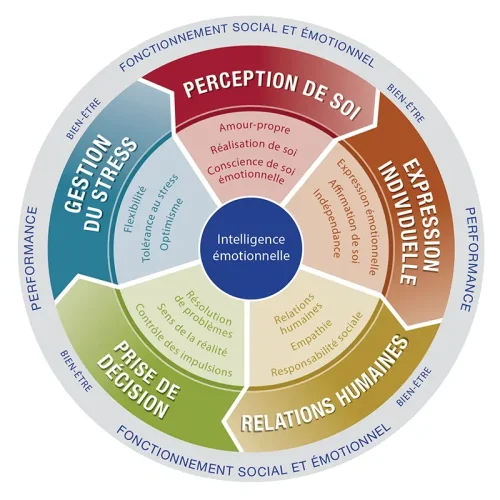
The most well-known questionnaire is the’EQ-i 2.0.
He organizes the results into 5 dimensions : self-perception, individual expression, human relationships, decision-making and stress management.
This is the wheel you see below. As you answer it yourself, it shows how you see yourself, and that's already a good starting point.
The MSCEIT, on the other hand, is an aptitude test built on the model of Mayer and Salovey: it presents you with situations, and your answers are compared to those of experts or a large sample of people.
The 360-degree feedback completes the package with the perspective of others.
What you do with the results matters more than the score. Choose one or two areas to work on, not all at once.
At Aktasens, the Confidence module of our Choosing Yourself assessment dedicates 2 hours to emotional intelligence with the EQ-i 2.0.
Our in-company training program begins with a diagnostic assessment., Leadership mapping, followed by a 1 hour 30 minute individual feedback interview.
Getting support to develop your emotional intelligence
We progress faster with an outside perspective and real-life scenarios.
For a team or group of managers, the in-company training is the most suitable format. At Aktasens, our emotional intelligence training follows 4 steps:
- A diagnosis starting point,
- A group workshop of one or two days,
- of the individual coaching sessions to go further,
- then a recap day 6 months to a year later, to measure progress.
It can be done in person, remotely or in a hybrid format, and it is eligible for funding by your OPCO.
For a single person, the individual coaching works on your own situations: relational coaching to better control your emotions and manage conflicts, or coaching with 360-degree feedback.
Emotional intelligence It also matters when you're considering your professional future: we explain why in our article on Emotional intelligence in a skills assessment.
One of our trainees was known for being very blunt, and some people felt attacked. The training helped him understand that this direct tone stemmed from a lack of self-esteem and difficulty managing his emotions: he spoke that way to protect himself from others' reactions. Through exercises to identify his emotions and their triggers, he learned to observe himself more closely and soften his manner of speaking.
You can also write to us through our contact form for a free initial exchange.
Your questions
At work, it helps to remain calm under pressure, to defuse conflict before it escalates, to make decisions with more perspective, and to understand what motivates others. These effects come from habits that can be practiced at any age.