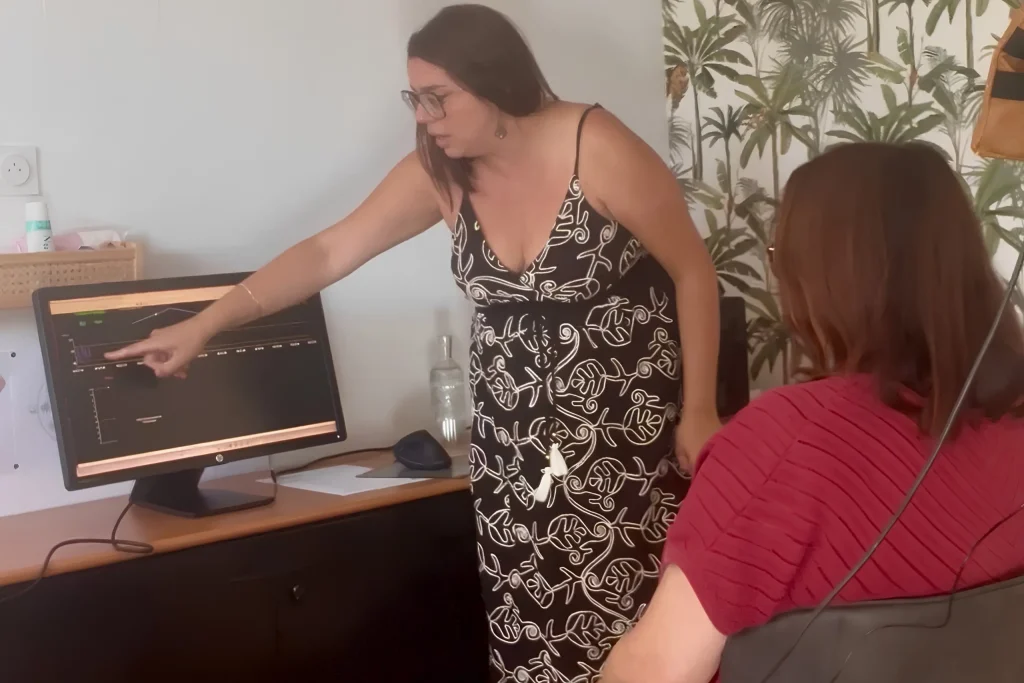
Neurofeedback and biofeedback: what is the difference and how can these approaches help you better understand how your body works?
THE neurofeedback It notably uses brain activity measured by EEG to provide real-time feedback. Biofeedback is based on a similar principle, but can also use other physiological signals such as respiration, heart rate, or muscle tension.
These approaches may be of interest to people experiencing stress, a heavy mental workload, or difficulties with recovery or attention. They may also appeal to highly sensitive, gifted, or neurodivergent individuals seeking to better understand their own functioning.
But perhaps the real question is not only that:
«"Can neurofeedback help me?"»
It could be:
«"What does my way of functioning teach me about how I need to live and work?"»
Because better understanding how it works can sometimes reveal that the problem is not necessarily related to its business.
It can be related to one's environment, pace, sources of stimulation, or the way in which one exercises one's skills.
What if what exhausts you comes not only from your job, but also from the way you function?
Regardless of whether you love your job, are competent, committed, and recognized for what you do, At the end of the day, you are exhausted.
Your brain keeps working when all you want is to switch off.
You may be able to concentrate for hours on a subject that fascinates you, then have great difficulty completing a task that seems simple to you.
Perhaps you need quiet time to reflect as your days are filled with notifications, meetings, and interruptions.
Or perhaps you have gone through a period of exhaustion and are now wondering how to avoid repeating the same pattern.
So, you're looking for solutions: Enterprise Coaching, Skills assessment, Therapy, Meditation, Neurofeedback, Biofeedback…
But behind all these possibilities lie much more important questions:
- Why do certain environments exhaust me so much?
- Why do I function very well in some situations and much less so in others?
- How can I better understand my needs?
- Do I really need to change careers, or do I mainly need to change the way I work?
- And what role can neurofeedback play in this discussion?
To answer these questions, we must first understand what the neurofeedback and biofeedback.
So, what does my way of functioning teach me about how I need to live and work?
1. Neurofeedback and biofeedback: what are the differences?
1.1 Neurofeedback: when your brain receives feedback on its own functioning
THE neurofeedback, also called EEG biofeedback, uses brain activity recorded by electroencephalography, or EEG.
In practice, sensors are placed on the head to record certain parameters of brain electrical activity. This information is then processed and transformed into visual or auditory feedback.
The person can, for example, watch an image, a film, or receive a sound signal that changes according to the protocol used.
The idea may seem complex, but the principle is relatively simple: Your brain produces an activity → this is measured → information is sent back to it → a learning process can gradually take place.
This is why we often talk about’feedback training.
This is not about reading your thoughts, nor about sending information into your brain.
The sensors record electrical activity and allow the system to provide feedback based on that activity.
Imagine learning to play tennis without ever seeing where the ball is going. You could repeat the same movement over and over without knowing exactly what's changing. But if you're told where the ball is going each time, that changes everything.
Neurofeedback is based on this same idea of learning: to receive feedback on a process which, usually, remains largely inaccessible to our awareness.
Research on neurofeedback These have existed for several decades. However, it is important to point out that scientific results vary depending on the protocols studied, the populations involved, and the objectives pursued.
The trap: believing that neurofeedback "reprograms" your brain.
No, neurofeedback is not about pressing a button to "fix" or "reprogram" your brain.
And no, you shouldn't imagine a person lying down while a machine modifies their brain activity for them.
EEG neurofeedback is generally presented as a non-invasive approach based on measurement and feedback.
1.2 Biofeedback: when the feedback relates to other signals from the body
Biofeedback is based on a similar principle; again, a device measures certain physiological parameters and provides feedback to the person.
But instead of focusing primarily on brain activity, it can also measure:
- breathing
- heart rate
- heart rate variability
- muscle tension
- body temperature…
The goal is to enable the person to better observe certain reactions that are usually automatic and to learn to regulate them more consciously.
You may have already heard someone say to you:« Breathe, it's going to be okay.».
But when you are very stressed, this instruction may seem abstract.
With biofeedback, you can observe certain physiological parameters in real time and see how they change when you modify your breathing or experiment with different techniques.
| Criteria | Biofeedback | Neurofeedback |
|---|---|---|
| What is measured | Breathing, heart rate, muscle tension, body temperature... | Brain electrical activity (EEG) |
| Sensors | On the skin (fingers, chest, muscles...) | On the scalp |
| Return received | Visual or auditory signal linked to a bodily function | Visual or auditory signal linked to brain activity |
| Objective | Consciously regulating an automatic bodily function | Learning by reflecting on one's own brain function |
The underlying logic is the same: transforming invisible information into concrete reference points to learn self-regulation. The two approaches complement each other more than they oppose each other.
Are neurofeedback and biofeedback really the same thing?
Yes and no.
Both approaches are based on a common principle: using measured information about your functioning to promote a process of learning and self-regulation.
The main difference lies in what is observed.
Biofeedback can measure various bodily signals: respiration, heart rate, muscle tension, etc. Neurofeedback focuses on parameters related to brain activity, usually recorded by EEG.
Biofeedback: "I observe what is happening in my body.""
Neurofeedback: "I observe certain parameters of my brain activity.""
These approaches are therefore not necessarily opposed. They can be complementary depending on the needs and objectives.
2. Neurofeedback: Why your way of functioning also matters in your professional life
2.1 Burnout, stress and mental overload: when the problem isn't just work
Claire loves her job; she enjoys solving complex problems, supporting her clients, and developing new projects. Yet, she ends each day completely exhausted.
She then thinks: «"I think I need to change careers."». But when she begins to analyze her daily life, she discovers something else: His problem may not be his business.
What exhausts him is:
- permanent interruptions
- the meetings that follow one after another
- the feeling of having to be available continuously
- the lack of time to work in depth
- the difficulty in truly disconnecting.
The job suits him., the conditions under which she exercises it much less.
This is where understanding how it works becomes particularly interesting.
- Some people need variety
- Other stability issues
- Some appreciate highly stimulating environments.
- Others need calm to give their best.
- Some can manage multiple projects simultaneously
- Others need to focus on one subject at a time
The real challenge, therefore, is not to determine whether one way of working is better than another, but to understand:
«"Under what conditions do I function well enough to be able to use my skills without burning myself out?"»
This question helps prevent burnout. After a burnout, the question changes slightly:
«"What do I need to understand about my own functioning so that I stop working against myself?".
A skills assessment allows us to explore these questions precisely: career paths, skills, motivations, values, needs and professional environments.
Neurofeedback can complement this approach, but it does not replace medical or psychological support when such follow-up is necessary.
2.2 Hypersensitivity, high potential, neurodivergence: what if the question was also about the environment?
Highly sensitive, gifted or neurodivergent people obviously do not form a homogeneous group and it would be reductive to attribute a single way of functioning to them.
However, some people may identify specific needs in their way of living or working.
For example :
- a high sensitivity to stimuli
- a significant need for calm
- fatigue after many social interactions
- a difficulty with interruptions
- a need for autonomy
- a very strong search for meaning
- an ability to concentrate intensely on certain subjects
- or, conversely, a difficulty in maintaining attention in certain situations.
These characteristics do not mean that a person is incapable of professional success; they can simply modify the conditions under which they function best.
In an article from Cerveau & Psycho, Brigitte Chamak, a historian of science, reminds us that neurodiversity is the idea that "human cognition is essentially diverse" and that conditions such as autism, ADHD or dys disorders are different facets of brain functioning.
She warns against a purely “positive” view: behind neurodiversity, there is also suffering, concrete obstacles (school, professional, social) and support needs.
Some have specific needs (emotional regulation, attention, tolerance to overload) for which tools such as the neurofeedback can be considered, without denying the suffering or falling into the trap of “everything can be solved by brain training”.
3. How can you tell if neurofeedback can have a place in your approach?
3.1 Start with your problem, not with the technique
Before you absolutely search for information on the neurofeedback, or biofeedback, or even how many sessions you would need, start by identifying the question you are really seeking an answer to.
For example :
- «"I am constantly experiencing mental overload."»
- «"I'm having trouble recovering."»
- «"My brain never stops."»
- «"I get overwhelmed very quickly."»
- «"I realize that I function differently from others and I would like to better understand my needs."»
- «"I want to avoid recreating the conditions that led to my burnout."»
Your needs should guide the choice of support, not the other way around, because the neurofeedback does not provide the same answers as a coaching or that a skills assessment.
A skills assessment will help you answer questions such as:
- «"What do I want to do?"»
- «"What skills do I want to use?"»
- «"What career path would be a good fit for me?"»
Coaching can help you work on your goals, decisions, obstacles, and actions.
Neurofeedback, however, belongs to a different dimension., It is precisely this complementarity that can sometimes be interesting.
It complements the approach for people who feel that before, or at the same time as, building their professional future, they need to regain more mental availability to take a step back, clarify their desires and start projecting themselves again.
3.2 The right criterion: not looking for a miracle solution
As with any method, ask questions to clarify your needs, such as:
- What is my goal?
- What type of neurofeedback is offered?
- How does the support process work?
- What exactly are we measuring?
- How is the protocol determined?
- How does this approach fit into my overall situation?
- What are the limitations of the method?
Beware of overly general promises, Scientific research on neurofeedback is active, but it remains marked by a wide diversity of protocols, methods and indications.
The best support is therefore not necessarily the one that promises the most, it's the one that is able to explain things clearly to you: what he proposes, why he proposes it, and what the limits of his approach are.
The real question is: «"What do I need today to move forward?"»
At Aktasens, we have chosen to explore this complementarity.
- THE skills assessment allows you to explore your background, skills, motivations, values and needs to build a career direction.
- THE coaching allows you to go further in self-understanding, decision-making and taking action.
- And the neurofeedback can provide a complementary approach to self-regulation and individual functioning.
This is, in particular, the philosophy of the journey New Momentum, which combines a skills assessment with four neurofeedback sessions.
The goal is not to promise you that four neurofeedback sessions will "solve" a complex situation. These sessions complement professional reflection within a broader approach because when looking to build the next stage of your professional life, it can also be helpful to ask yourself:
- «"How do I function?"»
- «"What gives me energy?"»
- «"What's overloading me?"»
- «"Under what conditions can I truly thrive?"»
This is the kind of thinking we seek to incorporate into our support services.
Conclusion
Neurofeedback and biofeedback are based on a particularly interesting idea: Our operations can become more visible.
And sometimes, a better understanding of how this works can lead us to ask different questions.
Perhaps the right question is not: "« How can I become more efficient?» but : «"Under what conditions do I actually function well?"»
Similarly, when going through a period of professional doubt, the question is not always: «"What career should I choose?"», It can be: «"What do I need to be able to work without burning out, use my talents, and build a professional life that reflects who I am?"»
At the house of Aktasens, We believe that a skills assessment should not only help you find a job title.
It should allow you to better understand your journey, your resources, your needs and the conditions under which you want to build the next chapter.
Whether you are in a period of transition, experiencing mental overload, a loss of meaning, recovering from burnout, or simply curious to better understand how you function, this reflection can be a starting point.
Not to become someone else but perhaps to gradually stop building your professional life against yourself.
If you would like to discuss your situation and discover how coaching or a skills assessment can help you, We invite you to contact us for a free, no-obligation initial consultation.
Neurofeedback and biofeedback FAQ
Biofeedback uses various physiological parameters such as respiration, heart rate, and muscle tension. Neurofeedback, also called EEG biofeedback, uses information related to brain activity measured primarily by EEG.
Sensors are placed on the head to record certain parameters of brain activity. This information is then used to generate feedback, often visual or auditory, depending on the protocol used.
Neurofeedback does not send electricity to the brain!
EEG neurofeedback relies on recording brain activity and providing feedback. It should not be confused with brain stimulation techniques that use an electrical current or a magnetic field.
There is no universal number of sessions. The number and frequency depend in particular on the objective pursued, the protocol, and the individual's situation. In the process New Momentum, four sessions are included as a complement to the skills assessment and not as a promise of a complete therapeutic protocol.
Yes, these approaches can be complementary because they do not answer the same questions.
THE coaching It focuses particularly on goals, awareness, decision-making, and taking action. Neurofeedback uses a different approach, based on measuring brain activity and providing feedback.
Because a career plan doesn't depend solely on your skills or the jobs that are hiring, it can also be helpful to understand your needs, your relationship to work, your sources of motivation, and the conditions under which you function best. Neurofeedback can then complement this reflection within a more holistic approach. skills assessment.