THE «"Career cushioning"» It comes to us from the United States, popularized in 2022 by LinkedIn career expert Catherine Fisher. According to a Robert Walters study from 2023 , 37 British executives already practice this reflex: maintaining their network, skills, and options, without actively seeking employment. In France, these steps are often reduced to a crisis management reflex.
This article defends a slightly different idea: Skills assessments should not only be a tool for rebuilding one's career. They can also become a fully-fledged career management tool.
Why has anticipating one's professional future become more important than finding the "right" job?
We think about our professional future when we need to make a change, for example, after a dismissal, burnout, or feeling fed up. What if you considered it even if you love your current job and feel good about it?
We spontaneously associate skills assessments with a professional crisis. However, more and more people are coming to see me without being unhappy at work. They are simply being strategic and objective.
That's exactly what the career cushioning describe : a plan B built just in case, while one is still fully invested in one's current position.
We consider it normal to get a health check-up before we get sick. Why should it be any different for our professional lives? Don't all managers have a list of potential replacements, drawn up upon their arrival, for themselves and their team members?
Should we wait until things get bad to think about our professional future, or is it something that should be considered when the brain is available and free, that is, when everything is going well?
1. Career cushioning: a still rare and often misused reflex
1.1 Why anticipate when everything is going well?
Thinking about next career steps does not mean actively looking for another job.
This allows, in parallel with its current activity:
- To maintain one's network, without waiting until one needs it,
- To identify one's transferable skills,
- To stay informed and proactive about changes in one's sector, particularly those related to artificial intelligence,
- To assess its market value without having to do so in a hurry,
- To reduce anxiety related to economic uncertainty…
In short, this allows you to be one step ahead and not wait until the last minute or until it is too late to plan ahead.
1.2 Why do most people still wait until the last minute?
For a long time, stability was valued: staying in a position for more than 2 years was seen as a sign of professionalism.
Thinking about evolving in parallel could be seen as a lack of commitment.
This framework has changed, but mentalities are struggling to keep up.
In reality, most people only begin this reflection when the situation becomes difficult to live with: an impending social plan, a reorganization, exhaustion or a loss of meaning that sets in.
It's often too late to think calmly.
Career cushioning is not done in panic, it is built in calm and serenity.
Is career cushioning only for people who are unhappy at work?
The short answer is no.
Observations on this subject are quite clear: the vast majority of people who practice career cushioning continue to be fully committed to their current position. They are not disengaging. They are simply preparing for the next stage of their professional life, the one they envision for the next 10 years. And they want to do so calmly, without pressure, without having to chase after a new job.
A skills assessment is therefore not reserved for moments of doubt or crisis. It can perfectly well be part of a process of anticipation and career management, just like a health check-up at the doctor's: not because something is wrong, but precisely to check that everything is fine, and to ensure that it remains so over time.
2. Why anticipating changes everything, even when you love your job
2.1 What our brain does to avoid asking the question
Psychologists Daniel Kahneman and Amos Tversky have shown that We systematically place more weight on what we risk losing than on what we could gain..
That's what we call loss aversion.
In addition to this the status quo bias : we generally prefer the current situation, even if imperfect, simply because it is familiar and predictable.
In practical terms, this means that we can stay for several years in a position that no longer suits us, because the unknown seems more threatening than discomfort.
Career cushioning cleverly bypasses this mechanism: it does not require making a decision, only exploring, without pressure.
2.2 The real question is not: "Am I unhappy in my current position?"«
The researcher Amy Wrzesniewski showed that We can experience our work in three different ways: as a job, a career, or a vocation..
Our view of our career can evolve over time, without a job having objectively changed.
So it's not just the question «"Is everything going badly?"» which matters, but this one "Does what I'm doing today still correspond to what truly matters to me?"«
You will be in full possession of your faculties if you prepare your next steps when everything is going well because your brain will be fully capable of doing so.
Waiting until things get out of hand risks depriving you of essential mental resources for measured and calm thinking.
What I observe in the accompanying process:
The people who come to see me while they are still thriving in their work are not looking to leave their jobs, they are looking to remain free to choose.
And it is often they who, in the end, remain the longest and most serenely in their current position: because they know that they are there by choice, not by default.
3. How to calmly implement your own career cushioning.
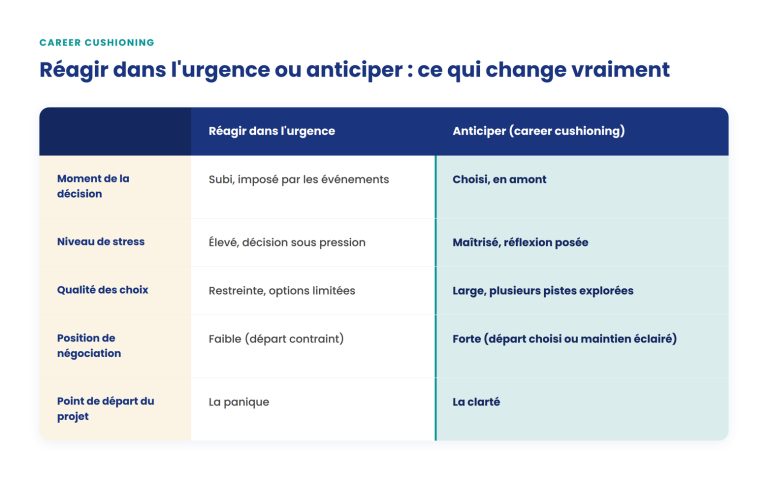
3.1 React in an emergency or anticipate consciously?
Being prepared and having everything under control are two different things.
You can have a clear vision of the possibilities without controlling everything, which protects you from impulsive and ill-considered last-resort decisions.
3.2 The right dose: neither in denial nor in constant vigilance
In my experience, after more than 3,000 hours of support, the strongest professional projects almost never arise in a rush.
The current economic context makes this anticipation all the more useful: according to the Future of Jobs 2025 report from the World Economic Forum , 39 % key skills of assets should evolve by 2030.
At the same time, Gallup estimates that only 21% of employees worldwide report being fully engaged in their work in 2026.
Two figures that point in the same direction: Staying attentive to one's professional development is no longer an option reserved for people in difficulty and is not a luxury!
That said, career cushioning is also not an invitation to constantly scan the job market out of anxiety about the future.
The goal is not to live in over-control of one's entire life, but to keep an intelligent, informed eye on what might be possible to do in case of an emergency.
In other words, to cover one's bases in order to act in comfort mode rather than resignation mode.
3.3 A framework for transforming this insight into a concrete project
The difficulty in this anticipatory approach is not running out of leads.
It's often about not knowing how to organize them, or how to distinguish a passing desire from a real signal to be taken seriously.
A skills assessment provides precisely this framework: a structured space to clarify what matters, what is transferable, and what truly deserves to be explored, whether to better position oneself where one is, or to prepare for a future elsewhere.
Conclusion
THE career cushioning This is not proof of disengagement. It is proof of pragmatism and discernment.
We take care of our health without waiting until we are sick. We can think about our careers without waiting until we are unwell.
The real question, therefore, may not be «"Should I leave?"», but rather: «"Am I ready if things change tomorrow?"».
At Aktasens, the skills assessment is specifically designed for this stage: a career management tool, not just
If you would like to discuss your situation and find out how a skills assessment can help you, We invite you to contact us for a free, no-obligation initial consultation.
FAQ on skills assessment and career cushioning
Career cushioning involves preparing a professional plan B (network, skills, market monitoring) while remaining employed, without actively seeking employment.
No. Most people who take this step remain committed to their current position. The goal is to keep their options open and reduce anxiety related to uncertainty, not to prepare for an imminent departure.
No. A skills assessment can absolutely be part of a proactive approach to clarify what really matters to you and prepare for future changes.
There's no universal rule, but the French government allows you to finance one with your CPF (Personal Training Account) or OPCO (Skills Operator) every 5 years. It's a good starting point that allows you to stay ahead of the curve without making it a constant worry.
Yes, of course, subject to the applicable eligibility requirements: a funding limit of €1,600, a remaining balance of €150, and a 5-year waiting period between two funded assessments. A consultation with a Qualiopi-certified organization will allow us to verify your specific situation.