Choosing your teen's career path isn't easy. Often it's not a
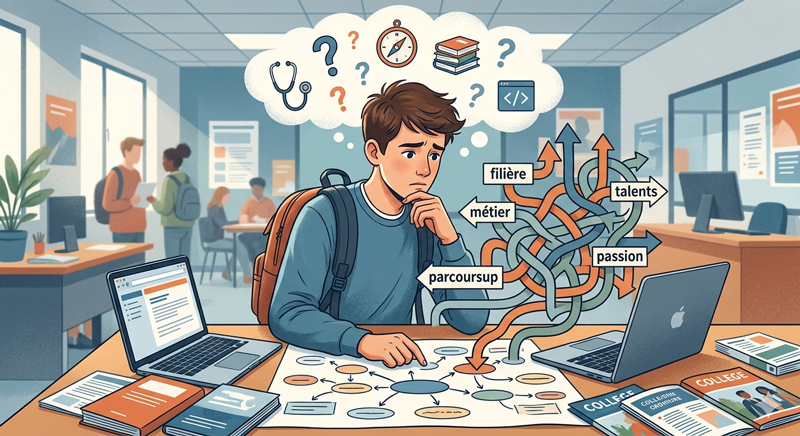
A lack of motivation, but also a lack of method. Today, young people are asked to decide very early without really knowing themselves. The result: default choices, stress, post-baccalaureate changes of direction…
This article explains how to make informed and aligned choices while respecting the
young, so that he learns to know himself, explore and decide for himself.
A concrete, structured approach that transforms "I don't know" into "I choose".
The real question is: are you ready to change your approach to truly help him?
Your teenager is in 10th grade. They need to choose their specializations for 11th grade, and therefore for their higher education and future career.
Except he doesn't know, he can't project himself that far ahead, he doesn't yet fully grasp the implications for himself. He struggles to understand that at such a young age, he's being asked to make choices when everything around him is in such a state of flux, changing so rapidly. Who knows if the jobs he likes today will have disappeared by then… Who knows what new jobs will be created in 10 years. And with AI, will we really have a choice?
You try to help him… but you feel that the more you insist, the more he shuts down.
– What if it wasn't a lack of motivation?
– What if it wasn't a lack of ambition?
– What if the problem wasn't finding "the right path"... but knowing
«"How to search?"
Increasingly early pressure to choose a career path
Decide early…without knowing each other
Today, teenagers are being asked to make important decisions as early as 15-16 years old:
- Specializations in high school
- Post-baccalaureate options
- Future career
56 % aged 18 to 24 regretted having made a poor choice of career path and Nearly 1 in 3 students changes their course of study after the first year.
Behind these figures, there is often an initial problem with guidance. However, at that age, self-knowledge is still under construction.
Only 20% students report being satisfied with the guidance support. offered by their high school. A majority say they lack concrete information about jobs and career paths.
How then can one choose when one knows neither the options nor oneself? How to decide when you don't yet know:
- What we really like
- What we're good at
- What motivates us deeply
As a result, young people make choices "by default," and they change direction later. Or they lose their motivation, lost in a sea of question marks. All of this generates stress for both you and them.
The myth of the "right choice"«
Many parents want to answer the question: “Which is the best
"A path for my child?"”
A legitimate question… but one that assumes there’s a “right answer.” What if there isn’t a right answer? What if searching for that answer is precisely the trap to avoid?
The reality is that there is no perfect choice. A good choice is one that is understood, embraced, and aligned with your values. It's the right choice for the moment, one that can evolve over time, made consciously, without unrealistic or excessive expectations.
The true role of a career guidance assessment
A guidance assessment It doesn't provide a ready-made answer. It doesn't hold the absolute truth. The young person has everything they need within themselves to decide. The goal is to...
reveal.
The academic and career guidance assessment It provides a method, a framework, and some realizations. The goal is not to say "you have to do this" but to allow the young person to say: "I understand why this is right for me."«
In practical terms, how does an assessment take place?
Contrary to popular belief, an assessment is not simply a test. It's a structured process, spanning several sessions, that alternates between reflection, discussion, and practical exploration. The high school student is supported by the consultant in their journey of self-discovery. They finally put words to their thoughts, feelings, and desires. "I don't know" is replaced by "I choose.".
Here is what we consider such as the key success factors of this support. The aim is to allow the young person to answer three questions.
fundamentals:
- Who am I?
- What truly motivates me?
- Where can I truly flourish?
Create a safe space for discussion
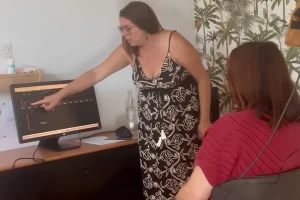
It all starts with a time for individual discussion where we create a bond and build trust. The teenager can speak freely in complete confidentiality, without academic pressure and without fear of disappointing their parents.
It's often the first time they're asked open-ended questions that lead them to express their doubts and formulate their desires (even if vague). It's at this moment that the first realizations emerge. That's the power of the approach of
coaching.
Getting to know yourself better (really)
The support provided is based on concrete and scientifically validated tools:
- Understanding of functioning and personality traits
- Analysis of motivations and drivers of personal growth
- Identifying natural talents
- Exploration of areas of activity and tasks
What makes the difference then are the exchanges that give meaning and clarity to the results. We decipher them and guide the student to understand and make them their own. Throughout their learning journey, they have access to a dynamic and user-friendly online tool, the MOTIVA®, used by thousands of career guidance professionals, such as APEC, CIBC, France Travail etc.
Explore without limits
Many young people think they have no ideas. In reality, they lack visibility. They don't know where to look or how to do it.
The assessment allows us to:
- Discover little-known professions of the present or the future
- Understanding the realities on the ground
- Explore the different study paths
- Making connections with their interests
Test, project, confront with reality
The field research, which involves interviewing professionals in the selected fields, is a key step because it doesn't remain purely theoretical. It moves from the idea to concrete projection:
- To envision oneself concretely in a profession
- Imagining his daily life
- Identify what he likes or doesn't like
This avoids idealized or unrealistic choices. According to the CIBC, an assessment with field investigation results in the total or partial achievement of the objective for 81% beneficiaries.
Your child develops a clear and realistic project. They leave with concrete leads, identified pathways, and a clear action plan. And above all, an understanding of why these choices resonate with him/her.
A youth-centered approach
Every young person is different.
There are as many career paths as there are students. That's why we take your teenager's individuality into account. We don't try to force them into a box. And creating this space is about building trust. Building trust means overcoming doubts, gaining confidence, dismantling limiting beliefs, giving yourself permission to value your strengths, accepting your challenges, and making your own choices.
« Without trust, there can be no decision. Without a decision, there can be no direction!»
To implement all of this, we believe in a balance between reflection and action. Here, we think and we act as well. We alternate:
- Time for introspection
- Practical exercises
- Scenarios
Genuine parental involvement (at the right time)
Parents are not excluded. On the contrary. But they are not at the center either. Because we believe that stepping outside one's personal environment, it's making a stepping aside and freeing oneself from potential family biases and obstacles. And above all, it's about stimulating critical thinking, a sense of responsibility, and autonomy in young people within a caring, neutral, and confidential environment.
Of course, time for discussion with parents is planned to define the project, its framework and its objectives beforehand, then to share progress and explore final directions without disrupting the student's momentum. You will be less worried, less stressed, and all will have more confidence in the path chosen.
Conclusion: changing your approach to change the results
What if the role of the parent was not to find the answer but to help their child build their own?
A career guidance assessment is not a miracle solution. But it is often the turning point that
allows you to pass:
- From blur to clarity
- From fear to action
- From “I don’t know” to “I choose”
And now ? If your teen is doubting, hesitating, or feeling lost, it might be a good time to help them in a different way. I suggest we discuss it openly and without judgment to assess the situation together. Write to us using our contact form for a free initial exchange.