What made us choose to integrate virtual reality applied to
neuroscience in our career guidance assessments?
Labor law requires skills assessments to include an exploration phase
personal and a phase of professional exploration. All reports must follow this
protocol. The tools chosen in these phases are, however, free and vary depending on the
Skills assessment centers. Aktasens has chosen to integrate digital innovation and
scientific programming is used for the following reasons:
A more refined, more precise self-knowledge
- You develop Therefore, by being aware of your emotions, you can better verbalize them and turn them into a strength when facing a challenge.,
- You improve your personal routines to increase your lasting well-being,
- You become aware you identify your strengths and limitations in terms of cognitive agility, and you take action to improve your adaptive skills.
The scientific validity of neuroscience
We use neuroscience and technology to profoundly impact the essential human skills of today. Science is now at the service of personal and professional development!
Of the Sensors and physiological measurements Relevant tools have been carefully selected to identify biomarkers of your mental well-being and assess your psychosocial skills, as well as psychometric measurement scales.
The results were checked to ensure the validity of the model. Thus, when the measurements are combined, we are able to predict with approximately 90% certainty the mental state we have induced in you.
This allows for the cross-referencing of unique data for a nuanced, holistic, and dimensional understanding of oneself and others, and the measurement of soft skills, and to bring you an understanding and tailored approach thank you for your support.
The innovative immersive experience of virtual reality
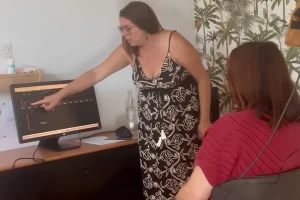
Settled in a comfortable armchair in a warm, padded space, with your virtual reality headset on and a certified coach to assist you, you'll immerse yourself in virtual worlds in complete privacy, learning while having fun and taking care of yourself and your mental health. Throughout the experience, sensors will measure your physiological signals. Each sensor can measure different parameters:

A detailed 24-page report: your cognitive & emotional assessment
The final reason that led us to choose this tool is the content of your debrief, which includes 24 pages of personalized descriptions for even more individualized support. With your coach, you will be able to explore your skills in depth:
- How do you see yourself? Our physiology has a direct impact on our emotional states and cognitive performance. We can see this by observing how food, sleep, or physical exercise can affect our mental states. By learning to identify your cognitive and emotional states, you will be able to adapt more easily to everyday situations.
You explore your potential by metacognition (awareness of your thoughts, your automatic behaviors, etc.), interoception (awareness of your emotions, bodily sensations, etc.), and you will have access to a radar chart that provides an overview of differences in measurements taken in a given situation compared to your self-perception. This means you will be able to observe in which areas you underestimate yourself and in which others you overestimate yourself.
- How do you react in challenging situations? ? In challenging situations, we mobilize our energy to understand the situation and find the behaviors that allow us to respond effectively: this is learning. Different profiles exist with regard to... energy mobilization, THE learning methods and the behaviors that we are putting in place to respond to these demanding and potentially stressful situations.
You will be able to observe your adaptability In stressful situations, your panel of strategies in challenging situations your intolerance of uncertainty, your alert and wakefulness level, your profile of resilience and your emotional reactivity.
- How do you recharge your batteries? Different environments and different methods allow us to recharge.
Explore here those that are best suited to you via the following themes: well-being, compassion towards yourself, privileged paths of access to happiness, fulfillment at work, respiratory rate, respiratory amplitude.
- How are you adapting? In challenging situations, we can draw on our past experiences and the flexibility of our bodies to cope. This allows us to be ready to welcome and respond to the stimuli of different situations. This is adaptation.
You will gain a clearer understanding of your sense of effectiveness, mindfulness, capacity for recovery and adaptation.
So, are you convinced? Personally, at least, just writing this article makes me want to...
to go back!